Explore how expanded states of consciousness can reveal patterns shaping identity, relationships, and leadership—and help you find a grounded next step.

Have you ever understood a pattern, promised yourself you’d do something differently, and then watched yourself repeat it anyway?
You know you over-function. You know you say yes when you mean no. You know the relationship, role, or way of working no longer fits. You’ve thought about it, talked about it, maybe even made a very impressive spreadsheet about it.
And still, something in you keeps going back to the familiar.
That doesn’t automatically mean you lack discipline, self-awareness, or courage. Sometimes the explanation you can reach with ordinary attention is only part of the picture. You may be trying to change a pattern while the assumptions and protections shaping it remain outside your view.
A habit that looks like procrastination may involve fear of what success will demand. People-pleasing may once have helped protect connection. Hyper-independence may have taken shape when asking for support didn’t feel safe. Those are possibilities to explore, not diagnoses. The useful question is: What is this pattern doing for me, and if it had a point of view, what does it believe would happen if it stopped?
What do I mean by “expanded states”?
I use expanded states of consciousness as an umbrella term for experiences in which attention turns inward and aspects of inner life—sensation, emotion, imagery, memory, and association—can become more vivid. Hypnosis is one familiar doorway into this territory, but the word alone doesn’t convey the range of perception and experience that may open with a skilled, highly trained facilitator. The facilitator’s role is to help you explore that wider field with care, curiosity, trust and grounding.
The Society of Psychological Hypnosis, an American Psychological Association division, defines hypnosis in terms of focused attention, reduced peripheral awareness, and an increased capacity to respond to suggestion. Researchers have also studied changes in brain activity and connectivity during hypnosis, though the mechanisms and best explanations remain active areas of research.
An expanded state isn’t a magic answer generator. It doesn’t make every image a historical fact or every feeling a reliable verdict. Instead, it can offer a different vantage point—one that helps you explore what may be shaping your responses, behavior, beliefs, and worldview.
That distinction matters to me as a board-certified transpersonal hypnotherapist. My role is to create a grounded, supportive process, follow the client’s experience, and ask questions that open up exploration. I don’t need to decide what an image means for someone else. The client’s own associations, body responses, and understanding need room to emerge. For clients who are new to accessing these states, I also help them stay with what arises and explore it in a way that allows deeper meaning to unfold—without supplying that meaning for them.
The body offers information. It doesn’t hand down a ruling.
We often talk about “listening to the body” as though the body gives simple, unmistakable instructions. It can be more complicated. Interoception—the sensing of internal bodily signals—is closely connected with emotion, and our interpretation of those signals is influenced by context and other mental processes.
A tight chest might be fear, anticipation, grief, exertion, or a mix of things. A sense of relief can be meaningful, but it still deserves curiosity. A feeling is data to explore, not an order you must obey.
HeartMath’s work on heart-rate variability, heart-brain interaction, and biofeedback offers a useful research conversation around physiology and self-regulation. Its research library includes a mix of peer-reviewed studies, independent research, dissertations, and the Institute’s own materials, so claims need to be tied to specific sources rather than attributed broadly to the brand.
This is where my practitioner experience and the research get to talk to each other—and things get interesting. Bodily cues can offer valuable clues about what’s happening beneath the surface. They don’t do the work for us; they give us more information to bring into emotional release, discernment, integration, and, ultimately, practical choices.
The blind spot may be the strategy that once protected you

Imagine a woman ready to set a boundary. She knows what she wants to say. But the moment she starts, her throat tightens, the words disappear, and her mind goes blank. Later, she berates herself, calling herself weak and pitiful for freezing. The moment becomes another piece of evidence for the old pattern—and it all happens in a microsecond.
In a guided inward exploration, she might discover that some part of her associates speaking up with rejection or conflict. That insight doesn’t mean she has to keep avoiding the conversation. It can help her understand why the response feels so strong and use expanded states to explore new, more supportive ways of being and moving through life. She may begin to see practical next steps—and experience what could be possible beyond the old pattern.
This is why root-cause-oriented work can be such a paradigm shift for people ready to explore change at that depth. Not everyone is ready for that kind of work, and that’s okay. The goal isn’t to excavate a dramatic explanation for every struggle. It’s to get curious about what a pattern may be protecting or helping someone avoid, what it costs them now, and what support might make a different response possible.
The same questions belong in leadership. What assumptions are shaping the options you consider? Which role are you still performing because it once earned approval? Where are you treating a familiar limit as if it were a fact?
When your perceptual frame leaves out a more aligned possibility, old patterns can make it hard to recognize that option at all. Expanded-states work can widen that frame, shift what feels available, and help loosen patterns that no longer serve you. Then integration begins, often quietly beneath the surface, as your subconscious and conscious ways of perceiving and responding reorganize around what you’ve discovered. And this doesn’t have to take a long time. This work can move quickly. As the new inner architecture stabilizes, more aligned choices can begin to feel natural. Think of it as an upgrade to your operating system.
Curiosity needs good boundaries
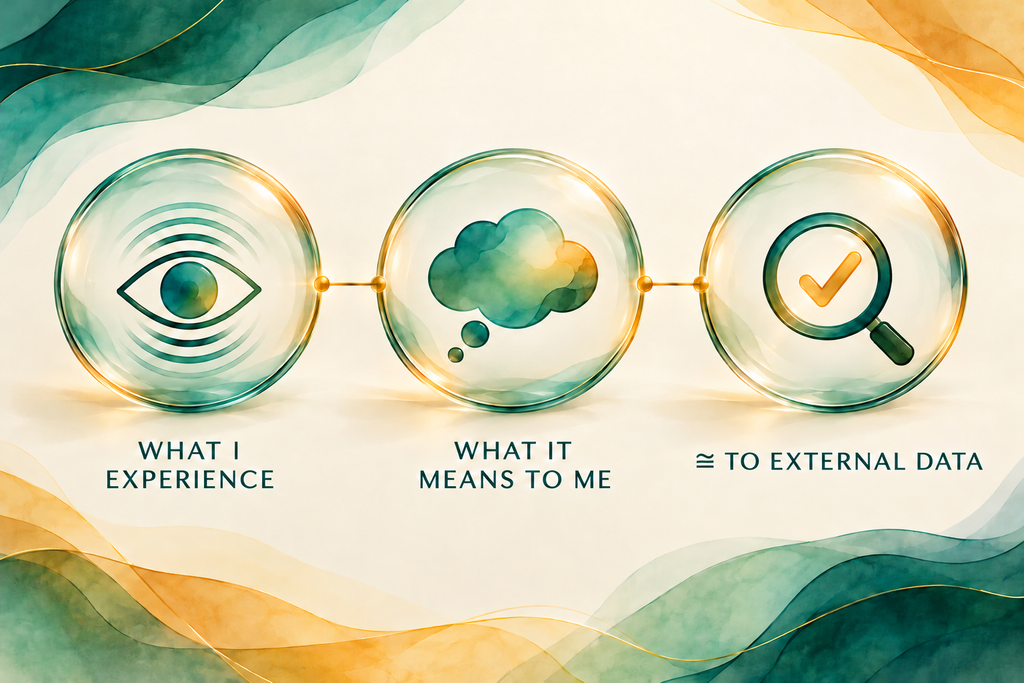
Expanded states can change what becomes available to awareness. In hypnosis, attention, emotion, body perception, and the felt quality of experience can shift alongside measurable changes in brain activity and connectivity. In a small EEG study, participants recalling their own near-death experiences under hypnosis reported a stronger sense of reliving them and greater similarity to the original experiences than during control recall. pmc.ncbi.nlm.nih.gov
Consciousness research has been reaching into conditions once considered impossible to study in real time. In the 25-site AWARE-II study, 11 of 28 interviewed cardiac-arrest survivors reported memories or perceptions suggestive of consciousness. Researchers also recorded periods of organized brain activity during CPR. IANDS’s peer-reviewed Journal of Near-Death Studies provides a home for research into these experiences and their implications for human development and consciousness. PubMed
Research on anomalous perception is asking another expansive question: can people sometimes register information without the usual sensory route? A registered-report meta-analysis of 113 Ganzfeld studies found a small but consistent average effect, with no decline across the decades studied and results that passed four publication-bias tests. The finding gives researchers a reason to keep investigating perception’s reach and limits. pmc.ncbi.nlm.nih.gov
Jung’s work offers a rich psychological lineage for taking inner images and experiences seriously. Through active imagination, he engaged images as material to explore and develop a relationship with—not as noise to dismiss. That approach still gives us useful language for how images and symbols can bring less-conscious material into dialogue with conscious life. IAAP
This is part of what makes expanded-states work so potent: it can bring perception, emotion, sensation, memory, and association into the same field of attention. In my practice, that gives clients a way to encounter patterns from a new vantage point, explore what those patterns mean, and begin reorganizing what feels possible.
A wider view creates room for a different choice
You don’t have to adopt a particular metaphysical belief to benefit from looking more closely at your inner world. You can be spiritually curious and discerning. You can value research and still admit that some questions remain open. You can listen to the body without handing it sole authority.
Sometimes the thing that changes a pattern is not another round of self-criticism. It’s seeing the pattern clearly enough to understand what it has been doing—and what else might be possible now.
That is the work I bring to my concierge-level one-to-one practice: a carefully tailored exploration of the patterns shaping how you live, lead, and relate, followed by grounded integration into your actual life. I also bring these questions to speaking and workshop audiences, because the way we perceive shapes what we believe we can create.
If you’re at a transition point and can feel that your usual explanations aren’t getting you where you want to go, learn more about my work at NoraYollesYoung.com.