

The Work and Leadership Opportunity of Becoming
The Fourth Essay in the Beyond Intelligence series
The Quickening explores how women’s leadership, expanded consciousness, and innovative thinking can help us build a more regenerative future.

Something is quickening.
We can feel it in the speed of technological change, the strain on our institutions, the unraveling of assumptions we once believed were solid, and the growing recognition that the ways we have been taught to live, work, lead, and make meaning may no longer be sufficient for the world emerging around us.
But a quickening is not automatically an awakening.
Change alone does not make us wiser. More brute power does not make us more mature. A firehose of information does not make us more conscious. And the capacity to build increasingly sophisticated technologies does not guarantee that we will know what those technologies should be in service of.
The real question is whether we are willing to let the quickening arise within us—to adjust, recalibrate, and become equal to the moment we are living in.
Our tendency is to solve multidimensional, living problems from within a linear, two-dimensional frame. We reach for familiar paradigms of control, efficiency, hierarchy, and extraction, even as those paradigms expose the very fault lines they can no longer repair.
We keep asking how to make our institutions more efficient and our leaders more decisive—often in service of profit over safety, vision, quality, beauty, human dignity, and genuine innovation. Too often, we follow the unconscious horse butt of the C-suite status quo: make technology more powerful, make workers more productive.
Optimize. Measure. Automate. Manage.
And women have long been expected to absorb the human cost of this model.
We absorb it in the invisible labor that keeps families, teams, communities, nourished, balanced and workplaces functioning. We absorb it in the emotional translation, anticipation, relationship tending, conflict-softening, and care work that rarely appears on a balance sheet. We absorb it when our perceptions are dismissed as “too emotional,” even when we are the first to recognize the problem, the risk, the unmet need, or the possibility no one else has yet considered.
This is not because women are inherently responsible for holding everything together. It is because many women have been trained to notice what systems organized around dominance, speed, and output routinely overlook.
That capacity is not a weakness. It is innovative intelligence.
The future will be shaped by more than speed, scale, or certainty. It will be shaped by leaders who can perceive complexity, hold competing truths, recognize interdependence, listen for what has not yet been said, and imagine structures that have never existed before.
This is not a lesser form of leadership. It is higher-order leadership: the capacity to bring expanded consciousness, discernment, and vision to the problems and possibilities of our time.
When leadership is reduced to speed, scale, and certainty, we easily slip into an us-against-them mentality—until “them” becomes everyone outside the narrow circle we have chosen to protect.
But we are the “them.” We are the collective.
Yet beneath all of these questions is a quieter and more potent one:
What if the model of the human being underneath our systems is simply too small?
Much of modern life still treats people as minds to be informed, bodies to be managed, consumers to be persuaded, and workers to be optimized. We are sorted by output, diagnosis, data, résumé, past patterns, usefulness, and our willingness to comply with the demands placed upon us.
In the process, we lose sight of the whole person: their lived experience, imagination, nervous system, relationships, intuition, moral intelligence, and capacity to create meaning, contribute uniquely, and participate in the long arc of human thriving.
Human beings are not fodder for productivity, no matter how thoroughly the dominant paradigms of business and “progress” have trained us to believe otherwise.
We are complex, perceptive, relational beings—carrying bodies, histories, inherited patterns that shape our nervous systems, wisdom, unique vision, intuition, creativity, and a capacity for awareness far more expansive than the roles we have been asked to perform. We are not machines to be mastered, controlled, or pushed beyond the limits of our humanity in the name of efficiency.
If we want to build a future capable of meeting the complexity before us, and supporting human flourishing over time, we will have to redesign the systems around us to reflect that truth.
The Flatland Problem

A two-dimensional model can only produce two-dimensional solutions.
It may look three-dimensional because it moves through time, accumulates data, and produces increasingly sophisticated outcomes. But at its core, it remains flat: it reduces living, multidimensional human beings to what can be counted, predicted, managed, or monetized.
It can make impressive things, certainly. It can process enormous amounts of information, organize complexity, predict patterns, and build tools with extraordinary speed. But when we mistake what can be measured for everything that matters, we begin to organize society around a profound reduction.
We forget that a worker’s creativity, a child’s curiosity, a patient’s lived experience, a community’s grief, or a leader’s moral courage cannot be reduced to a performance metric.
We also forget that some of the most consequential innovations begin at the edges of what a dominant system is willing to recognize. They begin with the person who notices an unmet need; the woman who sees the emotional labor draining her team; the founder who realizes a business model is profitable but not sustainable; and the leader who can feel a culture becoming brittle long before the numbers reveal it.
They also begin with the whistleblower willing to risk their livelihood, reputation, and safety to name the inequity of a system that can crush the very people who expose it—and often does.
Innovation is not only invention. It is perception made actionable.
It is the capacity to see what is missing, question what has been normalized, imagine a more life-giving alternative, and build toward it with courage and discernment.
We forget that analysis without humanity can become cruelty. That execution without meaning can become extraction. That intuition without discernment can become ungrounded projection. And that intelligence without conscience can become a more sophisticated form of self-interest.
This is the flatland problem: not that our systems lack intelligence, but that they have been built from a narrow definition of it.
The leadership opportunity before us is not to reject intellect, innovation, ambition, or technology. It is to place them inside a larger architecture of consciousness—one that recognizes the full human being and asks what our power, progress, and possibility are truly here to serve.
What My Work Is Teaching Me
I am watching this shift happen in real time through my work teaching students to facilitate expanded states of consciousness, and through my one-on-one work with people navigating their own quickening across every facet of their lives.
For many years, hypnosis was often taught through a model in which the practitioner was presumed to be the authority: the one who knew what a client needed to find, understand, release, or believe. The risk is not simply that the practitioner may lead a person. It is that the work can quietly ask someone to trade their own inner authority for another person’s interpretation of their life.
A client-centered approach asks something much more demanding of the facilitator.
It asks us to listen with precision. To notice without projecting. To create safety without controlling the outcome. To use skill, structure, and discernment without making ourselves the center of someone else’s experience.
It asks us to trust that the person sitting before us is not an empty vessel waiting to be filled with answers. They are already in relationship with a deeper intelligence.
But for that relationship to become available, people often have to loosen the grip of the thinking mind, the part of us that wants to explain, perform, control, anticipate, protect, and get it right. They have to feel safe enough to move beyond the narrow identity of personality and into a broader field of awareness: one that includes the body, emotion, memory, intuition, imagination, and the deeper knowing that can emerge when the usual noise quiets.
This does not diminish the intellect. The thinking mind is a remarkable instrument. It helps us analyze, plan, communicate, build, and make sense of the world. But it is not the whole orchestra.
This is significant because many of us have been entrained—hypnotized, if you like—to defer to other people’s rules as the primary guideposts of acceptability. Social norms, expertise, and shared structures are not inherently wrong; they can help us cooperate, protect one another, and navigate a complex world.
But when external authority becomes the only authority we trust, it can become a mechanism of control. It keeps people from developing the capacities to know who they are, recognize what they prefer, listen inwardly and relationally with discernment, and imagine what is genuinely optimal for their lives.
The intellect cannot, in isolation, tell us what deserves our devotion. It cannot determine what is meaningful for a particular human being. It cannot replace our capacity to sense what is true, stay present with complexity, repair relationship, or choose what our power will serve.
In a world still operating from the flatland problem, reclaiming those capacities is not self-indulgence. It is how we become able to vision and create lives, relationships, and systems that are more alive, humane, and coherent.
It also requires women not to tone down the energetic charge of their truth simply because it may trigger the familiar control-lockdown feedback loop—one that keeps visionary, perceptive people small, manageable, and “in their place.”
That box is unnecessary. It is simply the limit of what Flatland can imagine.
Beyond the flatland—beyond inherited rules, roles, and structures built upon foundational perceptions of fear and scarcity—there is far more potential for individual and planetary thriving than the old paradigm can currently envision.
A new way of living and leading is already emerging, creating the architecture of a new paradigm in real time. The flatland cannot imagine its way out of itself; it will require people willing to perceive beyond its edges.
These are not “soft skills.” They are capacities for original thought, ethical action, and meaningful innovation.
The most powerful technology available to us may not be one invented by a billionaire tech giant. It may be a human being who knows how to access her own deeper intelligence without surrendering her agency—and who is willing to build from what she can now see.
The Retrofit
If expanded consciousness is to become more than a private realization, our collective interpretive structures must expand to make room for it.
That does not mean turning every workplace into a retreat center or abandoning evidence, standards, expertise, accountability, or strategy. It means recognizing that each becomes more useful—not less—when held within a fuller understanding of what human beings need to thrive, create, and meet the far greater potential available to us.
The time has come to retrofit the ways we learn, grow, experience life, and evolve, individually and collectively, so that curiosity, emotional maturity, discernment, imagination, collaboration, vision, intentional courage, and relational intelligence are treated as essential capacities, not optional extras.
This requires learning environments where mental, emotional, and relational safety are woven into the culture through respect, attunement, and meaningful choice, not imposed through control, compliance, or forced agreement.
The people who will create what has not yet existed need more than instruction in how to perform well and arrive at the approved answer. They need to learn to ask better questions, live with uncertainty, recognize patterns, and trust their capacity to think, be, and express themselves originally and with confidence.
We must retrofit workplaces so that people are not treated as fodder for productivity, but as valuable human beings whose creativity, perspective, dignity, and well-being matter. A culture that requires chronic dysregulation, self-abandonment, or silence in exchange for belonging is not high performing. It is extractive.
This is especially consequential for women, who are often expected to absorb the invisible labor of the workplace: anticipating needs, managing the emotional temperature in the room, softening communication, holding relationships together, and noticing what others have missed. These capacities should not be quietly extracted while women are excluded from meaningful authority, authorship, and innovation. They are forms of intelligence that belong at the center of how we design, lead, and build.
We must retrofit leadership so that certainty and control are no longer confused with strength. The leaders we need can listen, integrate multiple perspectives, tolerate complexity, tell the truth, repair harm, and make decisions that serve more than their own image, comfort, or short-term gain.
The time has come to retrofit health and healing spaces so that people are not reduced to a diagnosis, a list of symptoms, or a problem to be solved. Rigor matters. Evidence matters. So do lived experience, nervous-system stability, meaning, context, relationship, and a person’s capacity to participate in, envision, and collaborate on their own healing journey—without the hubris of outmoded paradigms clinging to old ways simply because they are familiar.
Imagine technology designed to strengthen human attention, agency, discernment, and connection—rather than exploit our fragmentation or make us increasingly dependent on systems we do not understand.
We can envision tools that help us move beyond the flatland of what is currently perceived as possible: technology that supports deeper presence, creativity, collaboration, and our capacity to perceive more than the narrow data points available to the typical five senses.
Technology can expand human possibility without asking us to become more machine-like in order to keep up with it. It can become a partner in the expression of our extraordinary human capacities—in service of greater good, love, beauty, and the flourishing of life. Why the hell not?
We also have the opportunity to reimagine our relationship to expertise. Expertise is invaluable; it can anchor us in rigor, deepen our understanding, and help us make wiser choices.
But a mature culture does not ask people to abandon their own perception in the presence of authority. It invites a living relationship among evidence, lived experience, humility, intuition, and collective intelligence, one in which expertise informs human wisdom rather than exploiting, wounding and/or replacing it.
The future does not ask women, or anyone, to become more adept at feathering themselves into systems built without the full range of human intelligence in mind. It invites us to question the frame, name what resonates, and does not, or no longer resonates as coherent or true, and claim the clarity that helps create what comes next.
The Shadow Before the Expansion

In my one-on-one work with extraordinary people, I am seeing more and more individuals access information that does not arrive through ordinary linear thought. Their intuition becomes clearer. They receive what can only be described as blocks of knowing—not simply an idea, but an embodied recognition of the next right direction.
It can sound like: Oh. This is how I need to navigate this. This is what I need to do next.
The knowing does not necessarily arrive with a ten-step plan or certainty about every outcome, but it certainly can. It arrives as true resonance, as soul truth. Absolute Truth. Through this work a person will learn to become adept at feeling the difference between an old fear-based strategy and a direction that is honest, aligned, and alive within them.
Many begin to recognize themselves as part of a broader tapestry of consciousness, not isolated individuals struggling alone through a linear existence, but participants in a field of relationship that contains memory, possibility, past, present, future, and all that is still becoming.
Remembering that they are not here merely to be managed, contained, or made useful to somebody else’s structure. They are creators. Their unique brilliance does not need a domineering system to validate its existence or value.
There is something in human consciousness that cannot be extracted, automated, optimized, or owned.
It is the irreducible sacredness of a person: the capacity to create meaning, love, imagine, discern, make moral choices, heal, and participate consciously in the future they are helping to create.
Put people in a box. Oppress them. Silence them, if you can. But only for a time. The inevitability of who we truly are will keep pressing toward the light.
Why not design technology to support these capacities—rather than distort, diminish, or parasitize them in the name of progress?
For women, this remembering can be particularly charged. Many have been conditioned to doubt what they perceive, override what they know, accommodate what harms them, and wait for someone else’s authority to validate the reality they can already feel. The work is not simply to become more confident within an old structure. It is to reclaim the authority to recognize when the structure itself needs to change.
But this work cannot be navigated by expansion alone.
Before we can hold more power, perception, possibility, or access to our own inner knowing, we will be faced with what has been hidden in the shadows.
One of the deepest shadows is our belief in limitation: the lies we have been told, the lies we have inherited, and the lies we have learned to repeat to ourselves about what is possible in our lives and our future.
Fear often disguises itself as realism. It tells us that staying small is safer, that belonging requires self-abandonment, that our desires are too much, and that the future has already been decided by people with more money, power, credentials, or control.
Fear has an important protective function. It can alert us to danger and help us respond wisely.
But fear has little to offer as a creative strategy. When it becomes the lens through which we interpret everything, it narrows our imagination and reduces what we can perceive as possible. Fear becomes a prison when we treat every old alarm as truth. It has no authority beyond the authority we give it.
We can be thoughtful, strategic, and intelligent while allowing vision to be nourished through a higher perceptual lens—rather than defaulting to the familiar reflex of building from fear.
When people begin to integrate their shadow, they become more whole and more available to their own lives. They stop expending so much life force managing masks, suppressing truth, performing acceptability, or fighting internal wars.
Shadow integration is not a demand to excavate every painful memory, relive every wound, or turn ourselves into a project. It is the willingness to become curious about the parts of us we have learned to hide, judge, override, or disown.
It may begin with a simple question: What in me am I working so hard not to feel, know, need, want, or reveal?
Sometimes the shadow gathers around the core wounds we have carried for years: I am broken or not enough. I am alone. I am not emotionally or physically safe.
Anger can feel like an unloving response. Yet its wisdom may be telling us that a boundary has gone unrecognized. If we are willing to listen, anger can show us where a need remains unaddressed and where we must draw a line—not to close ourselves off, but to create the conditions for deeper honesty and connection.
Grief is the potent, nonlinear response to rupture and loss. We feel it in our viscera, and it can unsettle our sense of what is true. We so often dismiss it as something to “get over,” when what it asks is space to be witnessed and honored as we release what was familiar and find our way into a new normal. The loss may be a cherished pair of shoes or someone beloved. It may also be the realization that we buried our ambition, sensuality, sensitivity, brilliance, or desire for more because those parts of us felt too inconvenient, too threatening, or too much for the roles we were asked to play.
The shadow is not a flaw to eliminate. It is the place where disowned needs, untended pain, and unrealized potential have been waiting for a more compassionate relationship.
Shadow integration does not mean acting out every impulse or treating every feeling as fact. It means bringing what has been relegated to the margins into the light of awareness, where it can be met with the light of day, compassion, context and the opportunity to be felt, expressed and moved through.
This is where duality thinking begins to loosen its grip. We stop dividing ourselves into good or bad, light or dark, acceptable or unacceptable.
We begin to entertain the possibility that our personal shadow – the things we don’t like about ourselves and dare not show others – is not evidence that we are broken or failures. Our shadows are often reflections of the full spectrum of life within us, a spectrum we have been systematically taught to deny or suppress; grief alongside love, anger alongside boundaries, fear alongside courage, uncertainty alongside discovery.
When we can meet that spectrum with open curiosity rather than denial or self-abandonment, we become less easily controlled by the parts of ourselves we have been taught to reject or keep in the closet.
We become more capable of seeing expansively, trusting the signals arising in the unfolding of our lives and our place within it, while holding the complexity required to create something new.
We find a steadier center, become less dependent on external approval because we no longer have to discover what is true through other people’s perceptions of us. We can then recognize truth through our own sense of resonance: the quiet, unmistakable sense that something is honest, aligned, and deeply expansive and alive.
This is where innovation becomes more than a slogan. A person who is no longer organized around pleasing, proving, hiding, or merely surviving can see differently.
She can name what is not working without immediately collapsing into fear. She can hear differing opinions without collapsing into self-doubt, abandoning what she knows, or treating disagreement as evidence that she does not belong. She can tolerate the uncertainty of creating a path that does not yet have a map.
She can move from adapting herself to a broken system toward imagining and building something better. Leadership requires the same work.
A leader who cannot meet their own shadow will eventually ask others to carry it. It can show up as control, blame, defensiveness, greed, saviorism, people-pleasing, the need to be admired, the inability to tolerate feedback, or the compulsive need to dominate the room.
The more influence someone holds, the more consequential those unexamined patterns become.
The quickened leader does not rise by destroying relationships or leaving people behind. She rises by becoming more coherent, grounded in truth, responsibility, and inner authority. From there, she can create the conditions for courageous thinking, honest collaboration, and forms of leadership capable of meeting the future.
The work of becoming asks us to hold both truths at once: there is more available to us than we have been taught to access, and we must become mature enough to use what becomes available in service of life.
The Leadership Opportunity of Becoming
Nature has been demonstrating a more intelligent model all along here on Earth.
Nothing in a healthy ecosystem thrives by demanding the diminishment of everything around it. A forest does not become stronger because one tree dominates every other tree. It becomes resilient through relationship: diversity, reciprocity, adaptation, regeneration, and the constant exchange of information among everything that belongs to the whole.
There is competition in nature, certainly. There is predation, death, disruption, and the necessity of adaptation. But nature is not organized around endless extraction or the myth that one being’s flourishing must come at the expense of all others. Its deeper intelligence is relational, responsive, and palpable.
A healthy system responds and recalibrates. It makes use of what is available. It creates conditions for life to continue. This is true resourcefulness.
To deny the majesty of what has always worked in nature is to cling to a profoundly narrow (and humancentric) idea of success. We have been taught to admire the individual who rises above everyone else, accumulates the most, controls the most, and calls that achievement.
From the outside, the billionaire experience may look like the ultimate proof of success. But when we feel into the expression of the billionaire life, do you notice? Could there be something deeply off about a life organized around endless accumulation, influence, and control over the people affected by that influence? When resonance, relationship, and connection to the living whole fall away, what remains can look alien, distorted, and, frankly, not much fun.
Yes, vast wealth can buy an extraordinary amount of stuff, access, and power. But is the power to manipulate, control, and gaslight the beings of this planet, while creating ever more hierarchy, truly rewarding in the final assessment of a life? Is it meaningful to those perpetuating it?
This is not a judgment against wealth. Money itself is neutral. Wealth can create freedom, beauty, security, generosity, and the ability to do meaningful good.
What I am questioning is the elite, outrageous disparity between those who have and those who do not—and the deeper meaning of accumulation when it becomes isolation.
Ain’t it lonely at the top?
What circumstances have to be maintained to sustain oligarchical levels of wealth? What happens to a human being when their world becomes increasingly insulated by staff, security, status, dependence, and the need to protect what they have amassed?
In coercively controlling relationships, both the person exerting control and the person being controlled can become organized around fear, vigilance, mistrust, and disconnection. I wonder whether extreme systems of hierarchy create a version of that dynamic even for those who appear to “have” the most.
What might it cost in nervous-system regulation, trust in oneself and others, deep meaningful connection, joy, and the freedom to simply be human?
Your soul knows what is meaningful. Perhaps it is thriving, wellness, evolution, and personal sovereignty held within genuine support from friends, family, and community. If you’re like me, those are far more interesting and worthwhile pursuits. They ask something of us, but they lead toward a life we can look back on without regret.
What do we regret more: loving our partner, child, friend, or neighbor too deeply—or failing to check in, bring food when they are unwell, or offer ourselves as a resource when they need one?
That is what I mean by a path we do not regret. It is not grandiosity or self-sacrifice. It is the choice to remain connected, to participate in one another’s lives, and to leave the people and places we touch a little more resourced than we found them.
What if real success looks more like a unique life’s masterpiece: something only that person can create, and that leaves more life, possibility, and beauty in its wake?
What if it is measured by the degree to which our lives, leadership, relationships, and creations increase vitality, within ourselves, among the people around us, and in the larger systems we touch?
This is an invitation for women and all who resonate, to recognize the capacities they have often been expected to carry quietly as forms of intelligence worthy of visibility, authority, and influence.
Pattern recognition, relational awareness, long-range thinking, responsiveness, discernment, and the ability to perceive what a system is asking people to absorb are not merely private labor to be extracted. They are essential capacities for real innovation—and they belong in the rooms where we are deciding what comes next.
The next iteration of leadership requires more than disruptive ideas. They require the courage to ask whether what we are disrupting is making life more whole, viable, and possible for those who come after us.
The fantasy that more is always better—that we can accumulate enough wealth, power, technology, control, or distance from one another to live in isolation forever—is not a vision of freedom. It is a profoundly lonely way to live.
No amount of individual advancement can replace soulful connection with the living world and the ecology we all participate in. We are not separate from that web. We are shaped by it, sustained by it, and accountable to it.
A life organized only around taking, accumulating, and insulating oneself from the needs of others eventually becomes vampiric: constantly consuming, never truly nourished.
The hope is not to become untouchable.
The hope is to become deeply connected—resourced by, responsible to, and in meaningful relationship with the world we share.
That is not a sentimental vision of nature. It is an invitation to learn from the oldest, most observable, and most enduring intelligence available to us—and to build accordingly.
The Choice Before Us
The quickening is already here.
It is visible in what is breaking down, but also in what is trying to emerge: in the women questioning the roles that have required their diminishment; in the leaders refusing to confuse extraction with success; in the practitioners, founders, artists, parents, and builders creating new ways to relate, work, heal, and make meaning.
We do not need to have every answer before we begin. But we do need to become more honest about the questions we are willing to ask.
What is my life force currently serving?
Where have I mistaken adaptation for alignment?
What have I been trained to dismiss in myself because it did not fit the available model of intelligence?
And what might become possible if I stopped waiting for permission to trust what I can see?
The work of becoming is not about becoming exceptional at performing a new identity. It is about becoming more available to what is true: more discerning, more embodied, more responsible for the power we hold, and more willing to create from a vision of life that includes more than ourselves.
The future is not waiting to be handed down by the people who have benefited most from the old model.
It is being shaped now—through the choices we make, the systems we consent to, the relationships we tend, the truth we are willing to name, and the structures we are brave enough to build.
The question is not whether you are part of that future.
You already are.
The question is: what will you help create?
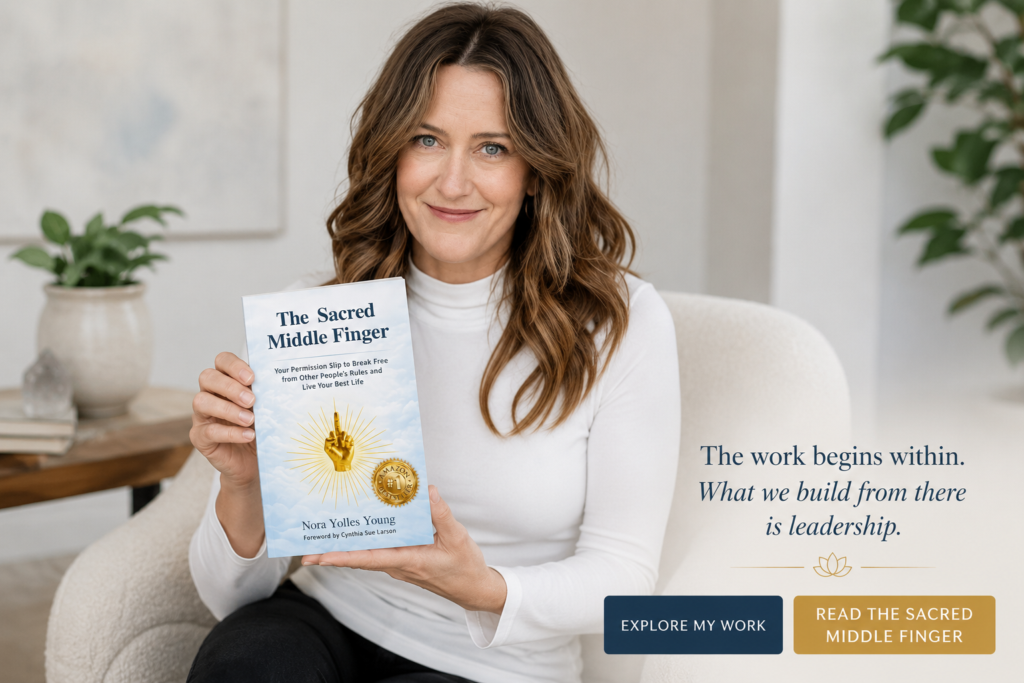
If you are a woman in the middle of a professional, personal, or spiritual becoming—and you are ready to stop shrinking your perception to fit an outdated role—I offer one-on-one work designed to help you reconnect with your own inner authority, clarity, and capacity to create what comes next.
Learn more about working with me
Continue Reading: Beyond Intelligence
- Beyond Intelligence: Why the Future of Leadership Belongs to the Most Attuned
How coherence and attunement expand perception, discernment, and leadership. - The Architecture of Perception
How meaning, attunement, and decisive action become exceptional leadership. - Beyond Intelligence: What Is Power in Service Of?
A call to move from extractive power toward regenerative leadership.