

The moral choice beneath leadership, influence, and human survival
The third essay in the Beyond Intelligence series.

Power without conscience becomes domination. Explore perception, planetary stewardship, and a more mature future for leadership.
In the first two essays of this series, I explored how perception shapes possibility—and how exceptional leadership requires more than intellect, strategy, or execution.
It requires a wider architecture of intelligence: attunement, discernment, maturity, collaboration, meaning, and the capacity to translate what we perceive into action.
But there is a more confronting question beneath all of it:
What is our intelligence in service of?
Because expanded perception without moral maturity is not necessarily wisdom. It can simply make a person more sophisticated at getting what they want.
Power without conscience does not become leadership because it is efficient, persuasive, strategically brilliant, or capable of commanding attention. It becomes more dangerous.
And before we can talk honestly about corruption, coercive power, greed, or moral bankruptcy, we have to be willing to look at the rot. Not only the rot in institutions. Not only the rot in the people who have learned to benefit from confusion, division, fear, and extraction.
The rot that can permeate a society when enough of us decide—consciously or unconsciously—that we would rather be led than awake.
This is not because human beings are bad at our core. I do not believe that. I think we are exhausted. Overstimulated. Afraid. Busy surviving. Trained to believe someone else is more qualified to decide what is true, what matters, what is possible, and where we are headed.
So, we become the third horse in a line of horse rumps making its way down the trail. Just follow that tush. We hand over our attention. We trade discernment for convenience, mistake familiarity for safety and become so accustomed to being told what matters that we forget we possess the capacity to look, question, sense, evaluate, and decide for ourselves.
And then, slowly—almost imperceptibly—we allow the people most comfortable with power to define reality for the rest of us. It is time to take the blinders off.
Power Is Not Leadership

We use the word leadership so casually that we often fail to distinguish it from influence, authority, visibility, status, wealth, or the ability to get people to comply.
But leadership is not the power to make people move. Leadership is the capacity to help human beings move toward something worth creating.
It has a relationship to truth, responsibility. To actual consequences. A relationship to the health of the whole. It understands that people are not raw material from which productivity, loyalty, votes, wealth, labor, or attention can be extracted. They are human beings: complex, intelligent, vulnerable, creative, and worthy of consideration and care.
Leadership asks: What are we building? Who does it serve? What does it cost? Who bears that cost? What happens to the people, communities, ecosystems, and future generations who must live inside the consequences of this decision? What are the arenas that benefit? Who loses? What will be done to optimize net benefit over profit?
Domination asks a different set of questions.
How do I keep control? How do I avoid accountability? How do I maintain the appearance of legitimacy? How do I get people to doubt themselves long enough for me to do what I intended to do anyway?
Basically: How do I protect my own ass and let everyone else absorb the consequences?
When power must operate through intimidation, behind-the-scenes coercion, abuse, blackmail, deception, fraud, distraction, neglect, humiliation, or the systematic destabilization of shared reality, it has already revealed its moral bankruptcy.
This is leadership rendered as theater: the performance of legitimacy while domination carries on behind the curtain. It is obnoxious, insulting, and absurd—and perhaps it is time to admit that it has also been one of our historical definitions of leadership: power that prevails, whatever it costs.
But it will not carry us where we need to go. Leadership has to become something better. It has to become embodied truth: the willingness to see what is real, take responsibility for what our power creates, and act in ways that strengthen rather than diminish the life around us.
Domination can never be a long-term strategy for human thriving. Like a parasite, it survives by draining its host—and eventually destroys the very conditions that sustain it.
The Corruption of Shared Reality

One of the most damaging forms of power is not merely the power to lie. Human beings have always lied. We can be self-protective, frightened, ambitious, ashamed, and deeply invested in preserving an identity we cannot bear to lose.
The more dangerous power is the power that asks us to abandon our own perception while the lie is being told. To accept that up is down and down is up. To believe that what we can plainly see is not actually happening.
To question our memory, our instincts, our values, our sanity, our compassion, and our ability to recognize basic cause and effect.
Most people know this dynamic from intimate relationships. An unfaithful spouse insists that the evidence is meaningless. A manipulative partner denies harm while explaining why the injured person is irrational, dramatic, confused, or responsible for the very behavior that hurt them.
The goal is not simply to conceal the truth. The goal is to make the other person lose confidence in their capacity to know truth at all. A society can be manipulated this way too.
When people are overwhelmed by contradiction, scandal, spectacle, outrage, misinformation, and the endless churn of competing narratives, discernment gets exhausted. It becomes easier to stop looking, to retreat into certainty, to follow the loudest voice, the most familiar tribe, the most forceful explanation, or whatever allows us to get through the day without feeling the full weight of what is happening.
This is why the quality of our perception matters so much. Perception is not passive. It is not merely noticing what is in front of us. It is the ongoing capacity to register patterns, question assumptions, sense incongruence, track consequences, and remain willing to revise what we think we know.
A person who cannot trust their own perception is easy to control. A people who cannot trust their shared reality is easy to divide. And a society that cannot distinguish truth from manipulation becomes increasingly vulnerable to anyone willing to exploit the confusion.
The Cost of Looking Away
We did not arrive here only because some people are willing to behave terribly. We arrived here, at least in part, because too many of us have been conditioned to look away. Again, this is not a moral indictment. It is an invitation to honesty.
Looking away is understandable. When our most immediate needs for safety, stability, belonging, health, and provision feel uncertain, it is intuitive to turn our attention toward what is closest: our families, our work, our bills, our private hopes, and the people we love.
It can feel stabilizing to believe that someone else has the larger situation handled. To trust that the people in charge must know something we do not—the bigger picture. To assume that the systems around us are sturdier than they appear.
It is tempting to keep following the horse in front of us. But trusting others does not require surrendering our own agency. Healthy interdependence is not learned helplessness, and valuing expertise does not mean abandoning our ability to recognize when something no longer makes sense.
The world does not need every person to become a policy expert, political strategist, activist, historian, economist, spiritual teacher, or full-time watchdog. That is not the point.
The point is this: Our greatest thriving, as individuals and as collective inhabitants of this planet, lies in honing the distinct perception, value, and wisdom each of us is here to contribute to the larger whole.
Too many archaic models of power and leadership keep human beings distracted from that deep, intrinsic value: our individual and collective intelligence, creativity, and capacity. They can profit from it as long as we remain disconnected from it.
Because the moment we remember what we carry—and what we can create together—we remember that we are designed for this level of brilliance – the jig is up.
From Outrage to Agency

The next generation of leadership is not something we have to invent from scratch. It is already wired within us. These capacities are the unexercised muscles of our untapped brilliance: deeper perception, morally sound vision and imagination, relational intelligence, creativity, discernment, courage, and the ability to recognize that our individual wellbeing is inseparable from the wellbeing of the whole.
Many younger people are already beginning to flex these subtle but powerful capacities. They are questioning inherited rules. Refusing false choices. Asking larger questions about justice, belonging, identity, sustainability, power, and what kind of future is actually worth participating in.
Acknowledging what has harmed us and what is dysfunctional is valid. It must be expressed. Grief has a place here. Anger has a place here. The refusal to normalize what should never be normalized has a place here.
Genuine healing has no shortcuts. It asks to be held in sacred reverence—with honesty, tenderness, and room for the full emotional reality of what has happened. The days of swallowing our responses, tamping down our feelings, and calling that strength must be recognized as part of the continued harm we perpetuate against ourselves, often in service of systems that benefit when we remain disconnected from our own truth.
But outdated, too, is the way we make known that something no longer works. Outdated is the old script of the village coming for Dr. Frankenstein with and angry mob with pitchforks and torches: collective outrage without discernment, passion that becomes groupthink, and the mistaken belief that reactivity is the same as agency.
The next shift tasks us with digging deeper. It asks us to peel back the layers of malaise, reflexive helplessness, and inherited reactivity that keep us from recognizing the agency still available to us.
It asks us to hold wrongdoing accountable from an unwavering center of truth—not from numbness, vengeance, or the reflexive impotence that leaves the work to someone else. It asks us to stay connected to what is human while tending the wounds within our communities, among the people we love, and alongside the healers, space holders, advocates, and steady-hearted people who help us metabolize what has happened—and alchemize the lead of our collective pain and wounding into the gold of what we are becoming.
We do not need less feeling. We need feeling held inside greater consciousness.
Like the shuddering of an animal’s body after it has escaped the hunt, our nervous systems need space to express grief, pain, injury, and fear. They need environments where those responses are witnessed with reverence—not treated as inconvenient disruptions to be hidden, managed, or pushed away.
For too long, human pain has been treated as an invisible adjunct: the “hysterical” woman removed from view, the young person told not to cry, the wounded body asked to stay quiet and carry on until some imagined day when there will finally be time to feel.
That day is not guaranteed to arrive unless we make room for it now. Healing requires spaces where the full truth of what has happened can be felt without shame, witnessed without spectacle, and allowed to move through the body without being mistaken for weakness.
Only then can grief reveal what matters, anger clarify a boundary, compassion remain present without excusing harm, and accountability restore dignity rather than reproduce violence.
Only then can the wisdom held within the full alchemical process emerge—the wisdom we cannot think our way into, rush toward, or access through bypassing what the body, heart, and soul still need to move through. This is sacred work – not to be missed. And only after we face our collective dark night of the soul do we reach the threshold of what our next iteration can become.
That is not a passive process. It is the act of choosing agency mature enough to create something better than what harmed us.
What do we have to contribute—not only to our own survival and thrival, but to the good of humanity as a whole, the wellbeing of this planet, and our readiness to become responsible planetary stewards and ambassadors to the world beyond our own?
Planetary Sovereignty
There is a form of sovereignty we usually think of as personal: the work of no longer arranging our lives around approval, inherited rules, fear of rejection, or what other people might think.
But perhaps it is time to scale that question. What would planetary sovereignty look like?
It would mean looking in the mirror, clearing the cobwebs from our eyes, and taking a deeper step into radical responsibility for what we are creating here. It would mean refusing to organize our future around the hubris of human exceptionalism—the assumption that we are the only intelligence worth considering, the only perspective that matters, or the only beings affected by what we build.
It would mean looking up, out, and beyond. Not as an escape from Earth—an excuse to say, “We screwed the pooch here; now we have to terraform Mars”—but as an expansion of responsibility.
Whether or not humanity is ever witnessed by other forms of intelligence, we can still ask: What would it mean to become a species worthy of being known beyond our own world?
Do we want to be recognized for our capacity to dominate, extract, destroy, and then deny the consequences? That is what we call the villains in our stories. Yet human beings rarely want to imagine ourselves in that role. We want to see ourselves as the heroes.
Perhaps it is time to start acting heroically.
Perhaps it is time to create some congruence between our inflated perception of ourselves and the persistent patterns of villainous behavior we continue to normalize. To recognize that we have been gaslighting ourselves for long enough.
Course correction requires owning our own hindering bullshit—and being willing to chuck it in favor of something more fruitful: an intentional return to our re-emerging capacity to see clearly, repair, collaborate, create, and steward from centered, aligned strength.
That is the kind of congruence that can support genuine thriving on—and within—the extraordinary planet we have inherited.
The truth is, we do not need an audience in the stars to make this question matter. We only need the courage to recognize that the way we treat one another, this planet, and the future is already a declaration of who we are becoming.
The Moral Purpose of Power

Power itself is not corrupt. Power is simply the capacity to affect change.
Contrary to popular belief, power is not reserved for the few. It exists within all of us. But many of us have been trained to doubt the source of our true power and to mistake force for strength.
Force is not strength. It is often the refuge of insecurity—the impulse to dominate another person’s will because we have not developed the inner authority to lead ourselves. It is the aggression of toddler-level development: No. Mine.
If we are serious about turning our gaze toward the stars, we will need to mature beyond this petty orientation toward force and into a more expansive capacity for coherent strength, emotional mastery, discernment, and genuine stewardship.
Consider how much of life within the great oceans of this planet remains unknown to us. Then turn that lens toward the stars. Are you begin to feel the largeness of what is before us?
Once we distinguish power from force, the real question becomes: What does our power serve? Does it expand agency, dignity, resilience, coherence, and possibility? Does it leave people, communities, and systems more capable, more connected, and more alive than it found them?
Or does it depend on keeping others confused, depleted, dependent, divided, and afraid? Does it strengthen the conditions that sustain it? Or does it extract from them until there is nothing left but profit, rubble, and exhaustion?
And what is wealth when only a few are permitted to hold it while the systems and people that made it possible are diminished?
That is not abundance. It is distortion.
We can see the isolation, misalignment, and deprivation of meaning that accompany a life organized around behaving villainously toward one’s own people and world. Whatever wealth, influence, or control such a person accumulates, it cannot create inner coherence.
In the quiet moments of stillness, that has to matter.
And what is abundance unless it can be shared? Who wants an ivory tower in isolation, surrounded by stacks of wealth and separated from the living world that made it possible?
Regenerative power functions within interdependence. It knows that real strength is not demonstrated by how much can be controlled or extracted, but by how much life can be supported to flourish. It does not ask only, What can I get? It asks, What becomes possible when we are all strengthened by what we create together? That is true prosperity.
Perpetual thriving cannot be built by burning out people to sustain a company, abandoning a community’s most vulnerable members, destroying the shared reality a nation requires to cooperate, or continually betraying one’s own humanity.
The same is true of leadership. Anything that depends on degrading the people, systems, or planet that sustain it is not strong. It is structurally unsound.
It may look powerful for a while. It may produce extraordinary short-term results. It may persuade people that it is inevitable. But it is already standing on borrowed ground—shortsighted, boorish, and incapable of sustaining what it consumes. If we intend to survive and thrive as a species, the empowering pivot is toward stewardship.
The Galactic Question
And it may be time to ask a larger question still: What are the universal, multidimensional, and—yes—galactic implications of what we are building here?
Whether you believe the recent cultural buzz around UAPs points to something profound, something mundane, or simply another distraction is beside the point. The possibility alone offers a useful mirror.
If another intelligent civilization were observing us, what would they see? Would they see a species in the early, awkward stages of maturity—still learning how to manage power, still wrestling with fear, greed, tribalism, and the impulse to dominate? Would they see a species so dazzled by its own cleverness that it is about to squander an astonishing planetary inheritance for the sake of short-term gain?
Or would they see a species standing at the precipice of a profound evolution—toward sovereign planetary stewardship and a more mature form of leadership?
It is hard not to imagine the cosmic version of: Oh, the toddlers are at it again.
There they are, living on an extraordinarily magnificent blue planet with breathable air, abundant water, breathtaking biological diversity, vast intelligence, creativity, spiritual capacity, and the technological brilliance to solve problems their ancestors could barely imagine.
And they are still arguing over whether everyone deserves dignity. Still caught in cycles of war, economic and class caste systems, and the dualistic fiction of “us versus them”—even though those they call them are also us.
Still destroying the systems that keep them alive. Still allowing immense human talent and resources to be absorbed by domination, extraction, distraction, and the desperate pursuit of more.
Maybe they’re not ready.
We are a little like the entitled trust fund child of a billionaire: given an extraordinary inheritance and every imaginable advantage, only to squander it on selfish pursuits because we never developed the maturity to understand the majesty of what we were holding.
But what if we did?
What if we became more interested in achieving the things that bring forth the best of our human and planetary potential? If Earth were our house—and we were inviting fascinating new friends over to see what we had built here—what would we be excited to show them?
Certainly, we would show them the pyramids. The ancient temples. The great works of art, music, literature, science, engineering, architecture, and human imagination. We would show them the places where people came together to create beauty, preserve wisdom, care for one another, and reach beyond what had previously seemed possible. We would be proud of those accomplishments.
Would we be equally eager to show them the ecosystems we have destroyed? The communities we have treated as expendable? The ways we have made profit from illness, loneliness, fear, violence, and the diminishment of human beings?
That discomfort is not a verdict. It is an opening—an opportunity to become more conscious, present, honest, and more capable of creating what we would be proud to share.
If it makes us squirm, perhaps that is because it touches a knowing we have not entirely lost. Somewhere beneath the noise, the numbness, the distraction, and the stories we have been told about what is normal, we know the difference between power that protects life and power that consumes it.
We know the difference between what is worthy of pride and what is merely familiar. Between what looks impressive and what is truly elevated. Between a civilization capable of extraordinary achievement and one mature enough to be trusted with its own capabilities.
That knowing changes the purpose of leadership.
Leadership cannot simply be the management of people, resources, and outcomes in service of maintaining the status quo. Its higher purpose is to help us create more life: more dignity, agency, balance, possibility, and more room for human brilliance to emerge.
It asks: What are we building? Who does it serve? What does it cost? Who bears that cost? What will this decision make possible—or impossible—for people, communities, ecosystems, and future generations?
It also asks: Are we trying to solve the future from inside a structure that was never designed to hold it? Are we willing to recognize that our static definitions of leadership may be constraining the very vision, creativity, and collective intelligence we most need?
Gone must be the age of static mechanization: the belief that human beings, organizations, and a living planet can be managed like machines—forced into predetermined shapes, optimized for output, and discarded when they no longer serve the system, leaving behind buried accumulations of scorched earth.
We are not machines. Earth is not a machine. Neither can be endlessly extracted from, manipulated, and expected to carry on without consequence.
What we need is not a better version of the old box. We need an altogether different architecture: leadership and planetary infrastructure organized around thriving. Systems that are responsive, relational, regenerative, and capable of evolving toward greater coherence, balance, creativity, dignity, and life.
A living ecosystem, not another cage.
Technology can help us get there. It can reveal patterns, connect ideas, automate labor, and expand the range of what is possible. But technology cannot do the work of human maturation for us. Technology cannot do what it is not designed to perceive.
It cannot access the intelligence of the divine. The soul. The deeper field of consciousness from which human meaning, moral clarity, visionary thought, healing, and genuine wisdom emerge.
For me, this is not merely an idea. In my work, the evidence is ever-present for anyone willing to look. We are not only biological beings managing a human life. We are spiritual, conscious beings having a lived, collective human experience—here, I believe, by choice: to evolve, to grow, to remember, and to become more fully capable of what we came here to create.
Technology may amplify and support what the human mind can do. But the work of becoming mature enough to use that power wisely belongs to us.
And it is precisely where the old power structure begins to fail. It was built to preserve itself through control, rigidity, secrecy, and the endless attempt to force square pegs into round holes—then manipulate the documents when the evidence refuses to cooperate.
Sorry, old guard. The world is changing too quickly, the consequences are becoming too visible, and too many people are remembering what their own perception is for. The future belongs to those willing to become mature enough to build something better.
The Moment We Stop Pretending
There comes a point in every failing system when hoping it will return to what it once was becomes another form of denial.
We may long for a past version of reality. We may wish that the people with influence would remember their conscience. We may hope that the evidence will finally become overwhelming enough, the harm visible enough, the suffering undeniable enough, that those responsible will change course.
Sometimes people do change. Individuals can grow. Institutions can reform. Repair is possible. But true course correction requires radical honesty.
It requires a genuine willingness to see harm as harmful; take responsibility and make meaningful changes; acknowledge the failure; and reconfigure systems around more life-affirming, wellness-oriented values.
It requires becoming different in action—not merely in language.
As they say: talk is cheap.
If moral clarity, public pressure, evidence, suffering, or the obvious consequences of their actions were enough to create transformation, we would already be living in a different world.
So, we get to stop making our future contingent on the conscience of people who have repeatedly demonstrated that conscience is not directing their choices. This is not hopelessness. It is the end of misplaced hope—and the beginning of reclaiming our own responsibility for what comes next.
Yes, it may feel deeply uncomfortable to look at and face. But discomfort can be the threshold of a more honest, empowered choice. It is the moment we stop waiting for an old architecture to save us and start becoming capable of building the new one.
Higher Ground

There is a principle often spoken about in disaster survival: the people most at risk are not necessarily those who lack intelligence or strength. They may be those who cannot quickly accept that the conditions have changed.
They keep expecting normal to return. They wait for another announcement. Another sign. Another person to tell them what to do. Another reason not to leave what feels familiar.
And while they wait, the water rises. I do not say this to create fear. Fear is already being used skillfully enough. I say it because reality is always kinder than denial in the long run.
Recognizing that a system is failing does not require us to collapse into despair. It gives us information. It asks us to adjust. To prepare. To look for higher ground. To gather people. To carry what matters. To become more resourceful, more connected, more discerning, and more capable of helping one another.
Higher ground is not a bunker. It is not an escape from humanity. It is the decision to build the conditions in which humanity can survive and thrive.
It is more truthful leadership, resilient communities, ethical businesses, regenerative systems, and courageous conversations. More people willing to develop the inner stability required to resist manipulation and the relational maturity required to remain connected across difference.
It is the willingness to create structures that do not require anyone’s diminishment in order to succeed. It is the decision to stop calling extraction success.
Beyond Intelligence
This is why the future of leadership does not only go to the most intelligent, articulate, forceful, wealthy, connected, strategic, or technologically capable among us.
Leadership in this new age rises through people with range: people capable of thinking and sensing through the art of heart-centered awareness.
People who no longer perceive others as lesser and therefore have no need to revert to low-maturity strategies of power and control. People who are unwilling to step on, diminish, or exploit others in order to feel elevated themselves.
People skilled at listening openly and deciding clearly. Receiving and acting. Holding complexity without abandoning clarity. Recognizing patterns without becoming paranoid. Feeling deeply without becoming immobilized. Remaining open without becoming gullible.
Those who know to the depths of their DNA that there is no room for corruption, psychopathy, sociopathy, or sadism in a healthy, galactically oriented civilization—one in which all life is valued and planetary thriving for all beings is the goal.
We need leaders who understand that intuition without discernment can become projection; that analysis without humanity can become cruelty; that confidence without curiosity can become arrogance; that execution without meaning can become extraction.
Leaders that are willing to ask and feel the difference between, Can we? but Should we? Not only, Will this work? but What will it cost in the long run? Not only, How do we win? but Who losses if this is won?
This is what I mean by Beyond Intelligence.
It is not a rejection of intellect, ambition, strategy, innovation, achievement, wealth, or power. We need all of those capacities. But we need them held inside a larger architecture of consciousness.
One capable of recognizing that human beings are not machines to be mastered. We are beings to be deeply valued with intrinsic worth. That the health of the individual and the health of the whole are inextricable, and inseparable. That no outcome is truly successful if it requires the destruction of the conditions that make life meaningful, livable, and possible.
Much of what I am pointing toward has not yet been widely imagined, practiced, or permitted within our current dominant systems.
It may emerge as radically new to this dense, dualistic, intellect-first age—not because these capacities are foreign to us, but because we have been trained to overlook them.
The solutions may have been in plain sight all along, rendered nearly invisible by thousands of years of linear thinking, inherited power structures, and the assumption that what cannot be measured or controlled cannot be trusted.
The work begins within, because no one leads outside of themselves.
We bring our wounds, fears, loyalties, blind spots, conditioning, maturity, integrity, and capacity for self-honesty into every decision we make. We bring them into every room. Every institution. Every relationship. Every future we help create.
So this is not an essay about someone else’s moral bankruptcy. It is an invitation to examine our own relationship to power. Where have we handed it away? Where have we used it carelessly? Where have we mistaken compliance for peace, numbness for safety, or silence for consent?
Where have we allowed ourselves to become the third horse in line because looking up felt too frightening, too exhausting, or too inconvenient? And where are we ready to become more awake? We know where the old pattern leads.
Haven’t we been on this hamster wheel long enough to recognize its destination? More extraction. More disconnection. More harm explained away as necessary, inevitable, or simply the cost of doing business.
We do not need to keep running in order to learn what this model produces. We have enough evidence. The opportunity before us is to step off—and begin creating from a different center.
The future will not be created by the people most invested in preserving what is failing. It will be created by those willing to perceive clearly, tell the truth, remain connected to what is human, and build what comes next.
What are you willing to contribute to humanity’s survival?
The Work of Becoming
The first essay in this series began with a multi-layered idea: the quality of our perception shapes the field of possibility available to us.
The second explored what happens when that expanded perception becomes more than awareness—when it is brought into relationship with meaning, attunement, discernment, collaboration, decisive action, and execution.
This essay asks the question underneath both:
What is all of that intelligence, power, and capacity in service of?
Because the future does not require us to become less intelligent, less ambitious, less innovative, or less powerful. It asks us to become mature enough to hold those capacities with conscience. To use them in service of life. To create from a wider field of perception, a clearer relationship to truth, and a more coherent understanding of what it means to thrive together.
That is the work of becoming. It is personal. It is relational. It is organizational. It is planetary.
And it begins within.
As someone who has always been curious about what lies beyond the obvious, I explore the practical applications of consciousness: how expanded perception can transform the way we live, lead, relate, and create.
My work bridges the seen and unseen, spiritual intelligence and practical action, with a particular focus on women, leadership, and human potential.
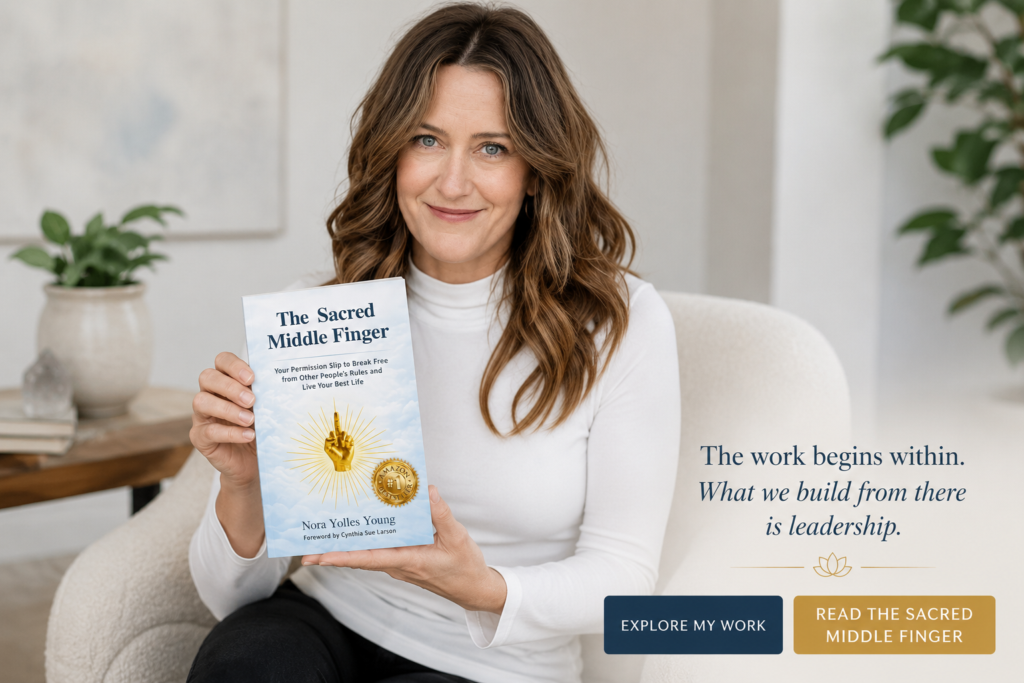
I’m Nora Yolles Young: board-certified hypnotherapist, certified instructor, Life Between Lives® practitioner, coach, and author of The Sacred Middle Finger: Your Permission Slip to Break Free from Other People’s Rules and Live Your Best Life.
I help people expand perception, strengthen self-trust, question inherited rules, and become more fully themselves—so that what they create in the world is a clearer reflection of who they truly are.
If this exploration resonates, The Sacred Middle Finger is an invitation to begin there: to examine the beliefs, loyalties, fears, and old identities shaping your choices, and reclaim the sovereign, grounded authority required to build a life that is actually your own.
Because before we can change the architecture of leadership, we have to become willing to examine the architecture within ourselves.
And before we can build a future worthy of humanity, we have to remember that we are part of its creation. What are you willing to release in service of a world worth living in?And what might become possible when we stop waiting for someone else to lead us home?